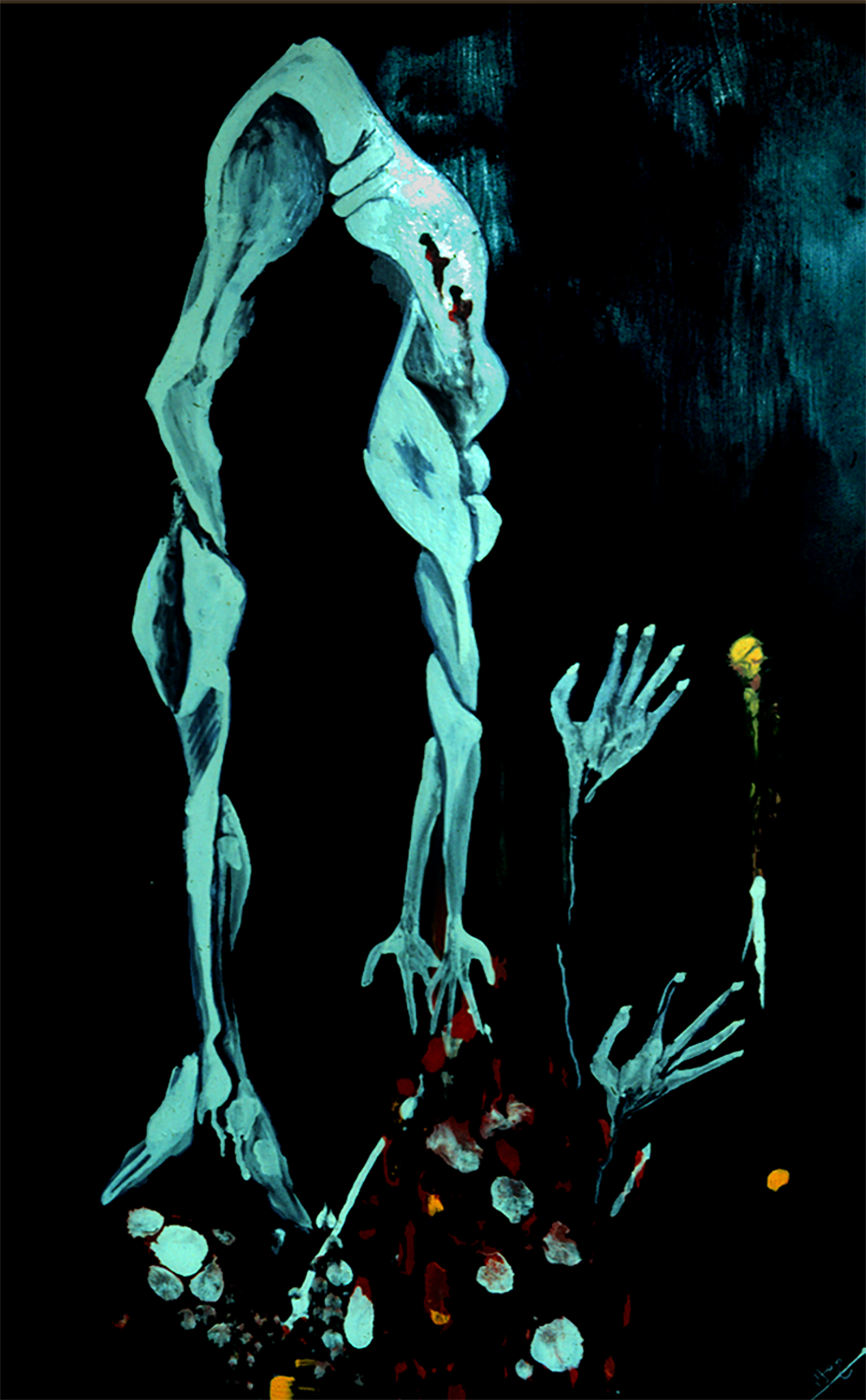
Oil on glossy cardboard · 24 × 36 inches
Created in the mid-1970s, "Ashraf" pays tribute to Hamid Ashraf, a prominent figure in the Iranian People’s Fedai Guerrillas, and captures the tumultuous years of revolutionary resistance leading up to 1979. Rather than depicting him realistically, the painting transforms the human form into a fractured, suspended composition—elongated limbs and disjointed hands emerging from a dense black void.
The figure appears both present and dissipating, as if caught in a struggle between memory and oblivion. Its pale, phosphorescent blue surface stands in stark contrast to the surrounding darkness, suggesting a presence illuminated at the brink of vanishing. Scattered hands and broken anatomical fragments extend beyond the central figure, shifting attention from a singular martyr to the shared fate of a generation.
Blood-like traces punctuate the artwork with a restrained intensity, presenting violence not as a spectacle, but as a remnant of history. The glossy cardboard surface reflects light unevenly, underscoring themes of instability and the fragile nature of remembrance.
Conceptually, the piece avoids both heroic glorification and political condemnation. Instead, it serves as a visual elegy for idealism that has been compressed into violence, acknowledging how repression and social turmoil transformed youthful conviction into tragic loss. By fragmenting the body and leaving the narrative open-ended, the painting invites contemplation on disappearance, collective memory, and the uncertain futures of those rendered expendable by history.
