Welcome to the M. Pourzand Art Gallery
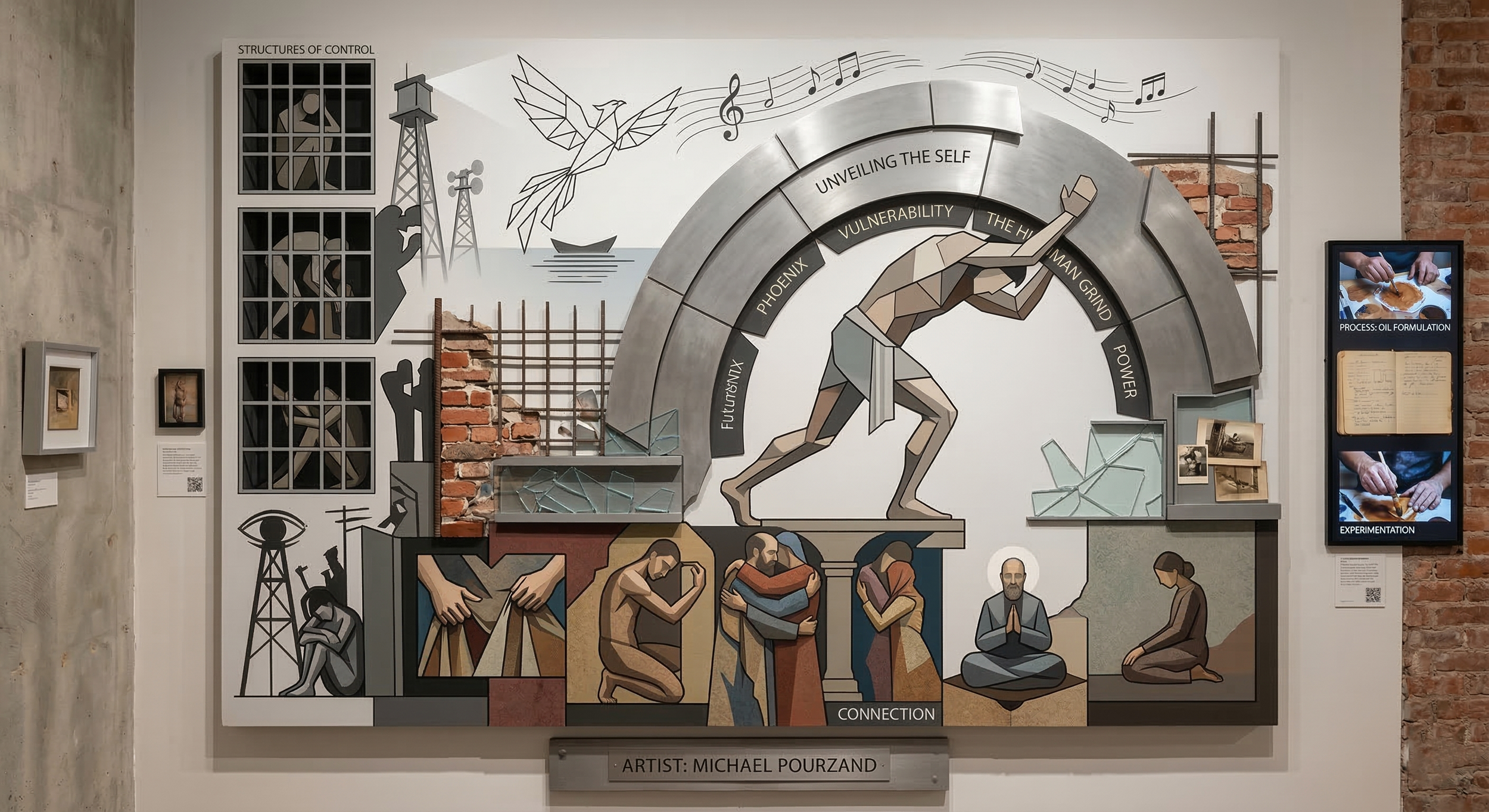
Welcome to a body of work shaped by decades of inquiry into structure—both built and lived. (IN MEMORY OF MY BELOVED SOULMATE, MINA)
Michael M. Pourzand, an artist, architectural photographer, and architect, has developed a visual language since the early 1970s through disciplined experimentation and reflection. Early necessity led him to hand-mix pigments and explore unconventional surfaces, fostering a deep understanding of materials.
Across oil, sealed pastel, graphite, and watercolor, his work centers on the human figure as a living structure through which myth, history, power, and memory take form. Through themes of endurance, systemic pressure, historical aftermath, and human connection, the works ask a central question: how does the human being persist within forces that exceed it?
-
Welcome to a body of work shaped by decades of inquiry into structure—both built and lived.
Michael M. Pourzand is an artist, architectural photographer, and architect whose visual language emerged in the early 1970s and continues to evolve through disciplined experimentation and philosophical reflection.
From the beginning, necessity became innovation. At 18, living in a small city with limited access to professional-grade materials, Pourzand began hand-milling dry pigments and mixing them with linseed oil to create his own paints. He worked on glossy-coated cardboard to slow absorption and better understand oxidation, surface tension, and chromatic depth. He later developed hybrid techniques—sealing pastel into textured surfaces to achieve luminosity and permanence while preserving immediacy. As a self-taught artist, this sustained process of experimentation forged an intimate knowledge of materials and a lasting sensitivity to the tension between fragility and endurance.
Description text goes here Across oil on canvas, sealed pastel, graphite on rough paper, and watercolor, one central inquiry persists:
How does the human being endure within forces that exceed it?The human figure stands at the center of this exploration—not as illustration, but as living structure. It bends under the weight of myth, history, power, faith, memory, and intimacy. It becomes the site where invisible pressures take visible form.
Mythology and mysticism enter not as ornament but as frameworks for thinking. From the Sufi act of Kherqe Daridan—the tearing of the cloak—to the Phoenix reborn through sacrifice, archetypes become vessels for paradox. Existential philosophy finds embodiment in figures like Sisyphus, the “absurd hero” who discovers dignity through conscious endurance. Heroism is redefined here as persistence in the face of fracture.
At the same time, Pourzand confronts the engineered structures of modern life. Industrial grids, arenas, cells, and machinery inscribe themselves onto the body. The monotony of labor, the weight of surveillance, systemic injustice, and political repression are rendered not as slogans but as posture—as the compression of space, the suspension of gesture, the anatomy of pressure. Power is not illustrated; it is embodied.
History appears not as a spectacle but as a psychic aftermath. Revolution, war, and human rights violations are translated into atmosphere—figures hovering at thresholds between conviction and fear. Memory flickers in unstable light. Ideals endure, yet remain fragile.
And yet, against burden and structure, another force persists: relation. Intimacy becomes architecture. Figures merge into protective geometries; proximity becomes belonging. Calligraphic rhythm preserves cultural continuity. Music, still life, and landscape emerge as acts of survival. Even the simplest objects—a boat, a book, a flower—carry quiet metaphors of renewal within uncertainty.
Throughout this gallery, geometry and flesh, light and shadow, solitude and connection intersect. The physical world and the interior soul remain in dialogue.
This is not merely a presentation of artworks. It is an invitation to reflect on endurance, to witness how structures shape us, and to consider how, even under pressure, something essential remains.
Welcome to a space where the body bears history, negotiates power, remembers, connects—and continues.xt goes here